

Ask three different BCBAs what their peers earn and you’ll get three different answers. Ask Glassdoor, Indeed and ZipRecruiter the same question and you’ll get three more. The numbers in circulation range from the high $60s to well over $120K, and the gap leaves nearly everyone in behavioral health, clinicians, hiring managers, finance leaders, guessing.
We had the same question. As a recruiting firm placing BCBAs across the country, we have access to something the salary aggregators don’t: real compensation outcomes from real placements. So we went through our records, pulled what BCBAs actually accepted at TYGES placements since early 2025, and built a calculator candidates and organizations can use to ground their expectations.
This post walks through what the data shows, where the public sources get it close, where they get it wrong, and what it means for anyone trying to make a compensation decision in behavioral health right now.
The Headline Number: $90,000
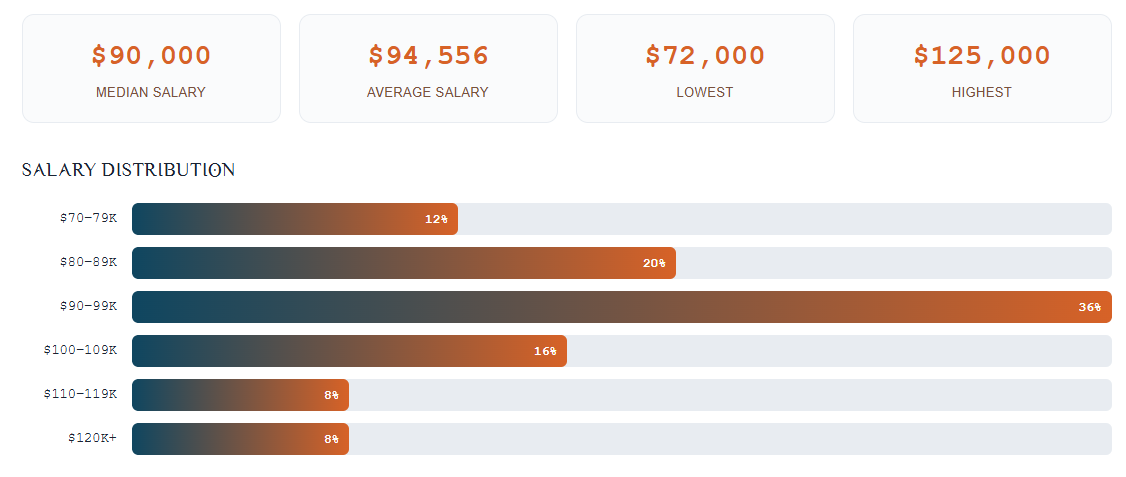
Across BCBA placements TYGES has completed since the start of 2025, the median placed salary is $90,000. The average works out slightly higher at roughly $94,500, pulled up by a handful of senior and director-level placements at the top end.
The full range is wider than most people expect:
- Lowest placed salary: $72,000
- Highest placed salary: $125,000
- Middle 50% range: roughly $87,000 to $100,000
Most BCBAs we placed fell between $90,000 and $100,000. Roughly one in five landed at $100,000 or higher. About one in eight came in below $80,000 — typically newer BCBAs, smaller markets, or specific organizational contexts.
That’s not a national survey. It’s our placement history. But it lines up well with what the broader market data shows, which is part of what makes it useful.
How Our Data Compares to the Public Salary Sites
If you’ve Googled “BCBA salary” lately, you’ve probably seen wildly different numbers depending on which site you landed on. Here’s how the major sources stack up, and which ones we’d trust:
| Source | Reported Average | Sample Size |
|---|---|---|
| Indeed | ~$90,720 | 68,000 salaries |
| ZipRecruiter | ~$89,075 | National aggregation |
| TYGES Placements | $94,556 (avg) | Recent placements |
| Glassdoor | ~$120,186 | 8,236 salaries |
| Salary.com | ~$73,950 (median) | Aggregated estimate |
The two sources closest to our data (Indeed and ZipRecruiter) both land within a few thousand dollars of our average. That’s reassuring: independent sources arriving at similar numbers is a stronger signal than any one of them alone.
The outlier tells its own story. Glassdoor’s $120K average likely reflects who chooses to report their salary, typically more senior or higher-paid professionals.
The takeaway: if you’re benchmarking BCBA compensation, the $89K–$95K range from Indeed, ZipRecruiter and TYGES placements is the most defensible national average. Glassdoor’s $120K is more aspirational than typical.
What Actually Moves a BCBA’s Salary
Salary aggregators rarely explain why one BCBA earns $80K and another earns $115K. The biggest factors we see in our placements:
Years of certified experience
Entry-level BCBAs (0–2 years certified) consistently start around $90,000 in current market conditions. From there, compensation rises non-linearly: faster growth in years 3–10 as clinicians take on supervision, develop specialties, or move into lead roles, then a plateau as direct-service positions hit a ceiling around the mid-to-high $120s. Beyond that, meaningful growth typically requires moving into a Clinical Director or higher leadership role.
Role progression
Direct-service BCBAs and Clinical Directors live in different compensation worlds. A 5-year BCBA earning $103K in a clinical role can step into a Clinical Director title at the same organization (or a different one) and see total compensation jump to $150K+. The premium reflects the leadership, oversight, and program-design responsibilities those roles carry. For BCBAs planning a long-term career, the move into clinical leadership is usually where the next major compensation step happens.
Specialty credentials
Bilingual or multilingual BCBAs command a real premium; typically around 5% over base, sometimes more depending on the market’s demand for specific languages. BCBA-D doctorate holders see a larger premium, often 10–15%. Specialized clinical certifications (feeding, AAC, severe behavior) add value too, though they tend to compound less predictably than language or doctorate credentials.
What we don’t see is these premiums stacking infinitely. A BCBA-D with bilingual skills and a feeding certification doesn’t earn three premiums layered on top of one another. In our placement data, the highest applicable premium tends to drive the outcome; additional credentials are valuable but show diminishing returns.
Sign-on bonuses
Worth flagging because they’re often overlooked in salary conversations: meaningful sign-on bonuses are now common in BCBA hiring. Our placement data shows typical sign-on bonuses ranging from $8,000 at the entry level to $15,000 or more for senior BCBAs and director-level roles. For candidates evaluating offers, total Year 1 compensation often runs $8K–$20K above the base salary, which can shift a “good offer” into a “great offer” or close the gap between two competing positions.
What This Means for Candidates
If you’re a BCBA considering your next role, three honest takeaways from our data:
- You should expect at least $90K as an entry-level BCBA. Offers significantly below that in current market conditions are below market, regardless of geography. The shortage we documented in our ABA Care Deserts analysis (roughly 290,000 more BCBA-level clinicians are needed than are currently certified) has shifted leverage toward candidates in nearly every market.
- Mid-career is where the leverage is highest. BCBAs with 3–7 years of experience are simultaneously in highest demand and most willing to move for the right opportunity. Organizations know this, which is why retention bonuses, supervision-track promotions, and meaningful sign-on bonuses are increasingly common at this tenure.
- Base salary isn’t the full picture. Sign-on bonuses, retention bonuses, productivity arrangements, supervision differentials, and benefits all factor into total compensation. Candidates who anchor on base salary alone can miss meaningful differences between offers.
What This Means for Organizations
If you’re hiring BCBAs, two observations worth grounding strategy around:
- Compensation drift is real. Compensation models built on 2022 BCBA salary assumptions are now meaningfully below market. The supply-demand pressure we documented hasn’t eased; if anything, the gap is widening. Organizations posting roles at 2022 salary bands are increasingly finding those positions stay open for months. The cost of an unfilled position usually outweighs the savings of a below-market offer.
- Sign-on and retention bonuses change the math. Several of our recent placements involved organizations that closed candidates not by leading on base salary, but by structuring competitive sign-on bonuses, retention bonuses tied to longevity, or generous PTO and CEU benefits. Total rewards packages, not just base, are how compensation-savvy organizations are winning candidates in a tight market.
See Where You Fit: The TYGES BCBA Salary Calculator
We built a calculator that lets BCBAs and hiring managers see exactly where a specific profile fits within current market compensation. It uses our placement data as the foundation, layered with experience curves, role progression, and qualification premiums we observe across our recruiting work.
The calculator is free to use, requires no email signup, and includes a second view showing the actual distribution of TYGES placement salaries so you can see how the estimate compares to real placements.
A Note on Methodology
Like our Care Deserts analysis, we want to be transparent about what this data is and isn’t.
- What it is: Compensation outcomes from BCBA placements TYGES has completed since early 2025. Each figure represents an actual placed base salary at a real organization.
- What it isn’t: A national survey, a peer-reviewed study, or a statistical model. We placed these candidates; we know what they accepted. That’s the strength of the data, and also its limitation. The sample reflects the kinds of roles and markets where TYGES recruits, which may differ from the broader BCBA labor force in ways we can’t fully control for.
To strengthen the picture, we cross-referenced our data against three independent national sources (Indeed, ZipRecruiter, and PayScale) and found close alignment around the $89K–$95K national average. That convergence gives us confidence the directional patterns hold beyond our placement history.
For BCBAs and organizations using this information: treat it as a strong directional benchmark, not a guarantee. Actual compensation will always vary based on the specific organization, the candidate’s exact profile, the local market, and the negotiation itself. The calculator is a starting point for the conversation, not a substitute for it.
For organizations looking to benchmark their BCBA compensation packages or candidates evaluating opportunities, the TYGES behavioral health recruiting team is happy to discuss specifics. Reach out online or call (757) 345-2494.